
What makes us human? Humanoid builds robots to take on the work that holds us back
· Slush, Helsinki

Artem Sokolov (Humanoid) on the Builder Stage at Slush, presenting The full-stack playbook.
Photo: Lars-Fredrik Forberg / Robotics Norway
Robotics Norway president Lars-Fredrik Forberg attended The full-stack playbook, a keynote by Artem Sokolov, founder and CEO of Humanoid, on the Builder Stage at Slush in Helsinki on Thursday 19 November 2026, day 2 of the event. Humanoid, founded in London in May 2024, is valued at 1.35 billion dollars after a 152 million dollar Series A in July 2025, with 270 million dollars raised to date. The company has more than 350 people in London, Boston, San Diego and Vancouver.
Sokolov's argument was that a useful general-purpose robot cannot be built with scripted control, and that hardware or AI alone will not be enough. "The future of physical AI won't be defined by hardware or AI alone. It will be defined by how well they work together," he said. Full stack, as he described it, means hardware, AI, data and deployment built as one system, with one company accountable for the result.
The work that still needs a body
Even in the digital age, Sokolov said, the world still runs on physical work, and there are not enough people to do it. By 2030, 85 million jobs could go unfulfilled, and by 2050 there will be 1.6 billion people over the age of 65, more than twice as many as today. About three million people die each year from accidents and disease at work. People also spend more than 60 billion hours a day on unpaid housework and care. Humanoid robots, he argued, can fill jobs that stay empty and take on work that harms people, in a world of factories, tools and homes designed for the human form. The human shape also helps with training, because most of the training data comes from people.
The timing, he said, is now right. A robot can run on a single end-to-end AI model and work on its own with the reliability industry needs, and with reinforcement learning a new skill can be taught in one working day. The constraint is no longer only the brain. Hardware supply is the bottleneck: the entire industry, he said, will produce only around five million robots by 2032, too few for the demand. A design principle he set out was to build hardware today for the AI that will exist in three years.
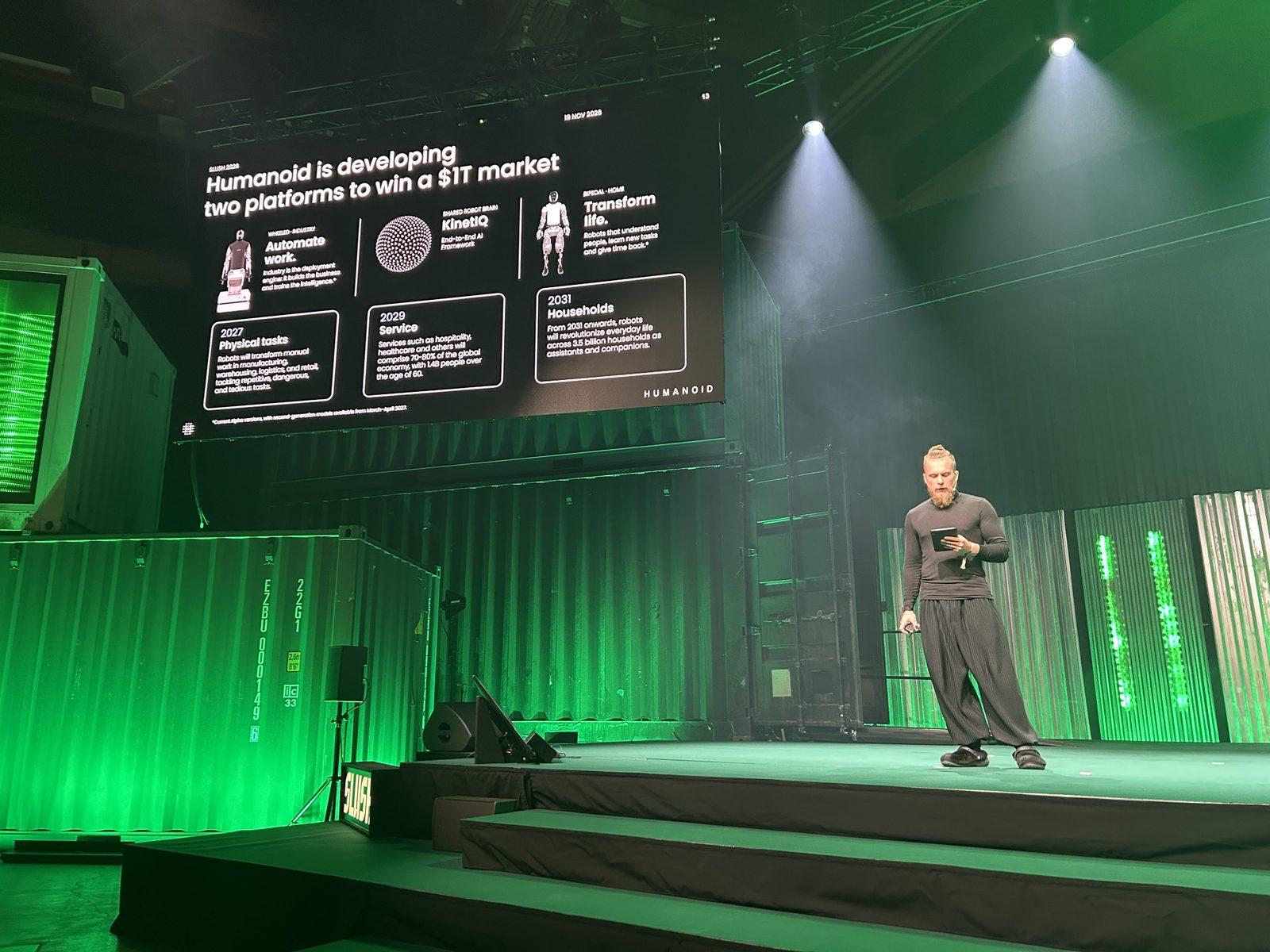
Artem Sokolov (Humanoid) sets out two platforms — a wheeled factory robot and a shared KinetIQ brain — on a path from plants in 2027 to homes in 2031.
Photo: Lars-Fredrik Forberg / Robotics Norway
Humanoid is developing two platforms, with KinetIQ as a shared end-to-end AI framework. The first is a wheeled industrial robot, which Sokolov called the deployment engine that builds the business and trains the intelligence. The plan is to start with physical tasks in manufacturing, warehousing, logistics and retail in 2027, move into services such as hospitality and healthcare in 2029, and reach households in 2031, as assistants and companions. The company is also developing a bipedal home platform. The goal, he said, is a general-purpose robot that can handle 90 percent of industrial tasks by the end of 2027.
Hardware, tested before the metal is cut
The stack has four parts: hardware, co-designed with AI from the first sketch; AI, with KinetIQ as one brain for the whole fleet; data, from simulation, teleoperation, deployment and reinforcement learning in one loop; and deployment, a capability factory that turns a customer's task into a robot skill.
On hardware, Humanoid uses digital twins and simulation before any metal is cut, in a six-week iteration cycle, testing concepts in NVIDIA Isaac Sim against worst-case scenarios. Sokolov said the company built its first industrial robot in seven months, against an industry average of 18 to 24 months. A walking policy transferred from simulation to a bipedal prototype in 48 hours. The core product on stage was the wheeled robot: a 20-kilogram bimanual lift, actuators co-developed with Schaeffler, and batteries the robot swaps itself, in two 750 watt-hour modules of about seven kilograms each, for up to 99 percent availability.
KinetIQ, and robots that practise the job
KinetIQ is a four-layer architecture. System 3 coordinates the fleet and sits under the customer's business systems and a fleet-management layer. System 2 handles planned actions and reasoning. System 1 is a vision-language-action model for learned skills such as pick-and-place, kitting, navigation and inspection. System 0 is whole-body control and motion. One brain runs the entire fleet, and skills transfer across all robots.
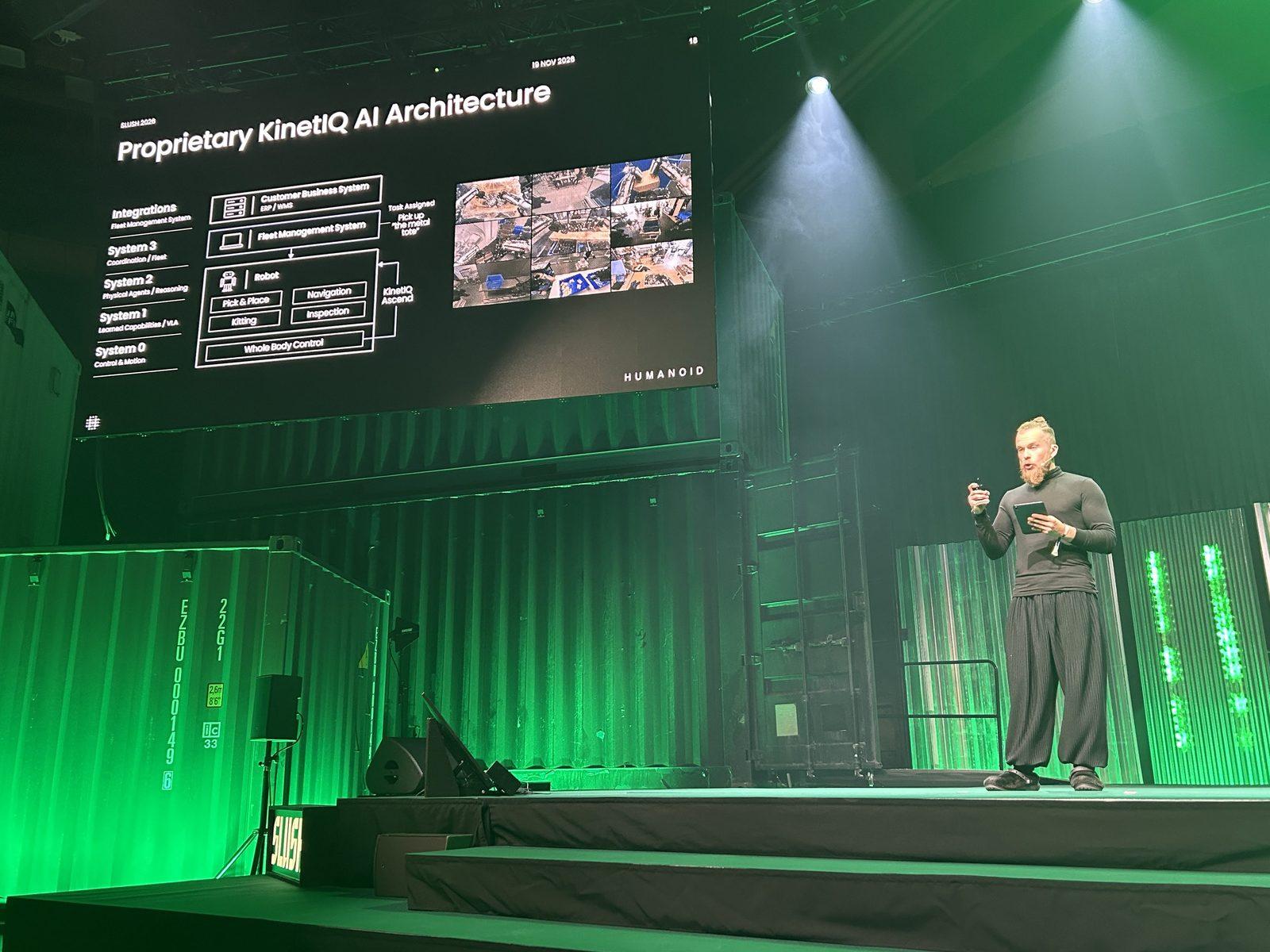
Artem Sokolov (Humanoid) describes KinetIQ, a four-layer brain that runs the whole fleet, from body stability up to fleet coordination.
Photo: Lars-Fredrik Forberg / Robotics Norway
Models are first trained on simulation and human demonstrations, then improved with reinforcement learning on real robots. That practice layer is called KinetIQ Ascend. Robots practise real production tasks around the clock and learn from their own successes and failures, driving the vision-language-action policies towards a target of 99.9 percent success at human or superhuman speed. On a bimanual tote-handling task, four days of real-world training took the success rate from 77.8 percent to 98.9 percent, with 20 times fewer failures, and raised throughput 2.3 times, from 122 to 279 totes an hour. The gains also transferred to objects the robot had not seen, at around 40 percent faster on new products.
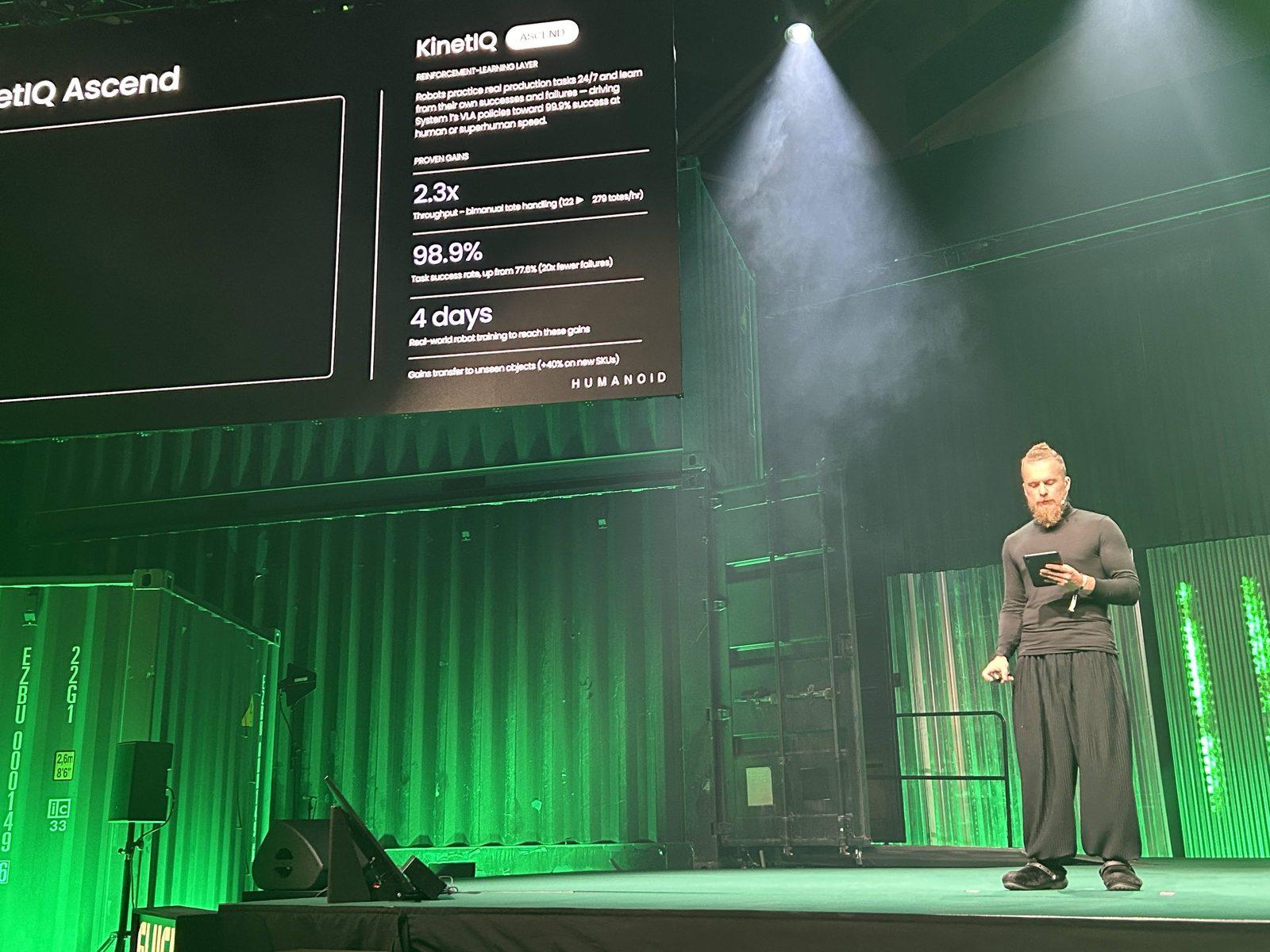
Artem Sokolov (Humanoid) shows how KinetIQ Ascend lifted a handling task from 77.8 percent to 98.9 percent success in four days of practice.
Photo: Lars-Fredrik Forberg / Robotics Norway
Data is treated as a moat. The aim is to build the world's largest industrial robotics dataset and also to sell data to frontier AI labs. The four sources are simulation and synthetic data, teleoperation, wearable devices — Humanoid showed proprietary UMI devices — and real robot data from customer sites, which Sokolov described as the most valuable and the hardest to get, because it depends on trust. The company is also building robot gyms and a partner network to lower the cost of collection.
From proofs of concept to a factory contract
In the past 18 months, Humanoid has completed 11 successful proofs of concept with global industrial companies. The next step is long-term deployment. With the tools of its capability factory, Sokolov said, a customer can add a new task in a couple of days instead of paying for a custom automation project. He pointed to one bin-picking case at more than 800 units an hour, described as human parity, through simulation-to-real reinforcement learning.
In May, Humanoid signed a binding agreement with Schaeffler in Germany to deploy wheeled robots across its plants. The slide put the target at 1,850 units, with a potential value of around 300 million dollars. Schaeffler had completed two proofs of concept, Sokolov said, then signed a contract, then invested in the company. Humanoid is in conversation with 130 companies, and 80 of them are in advanced discussions. The same slide showed 33,650 non-binding pre-orders secured to date.
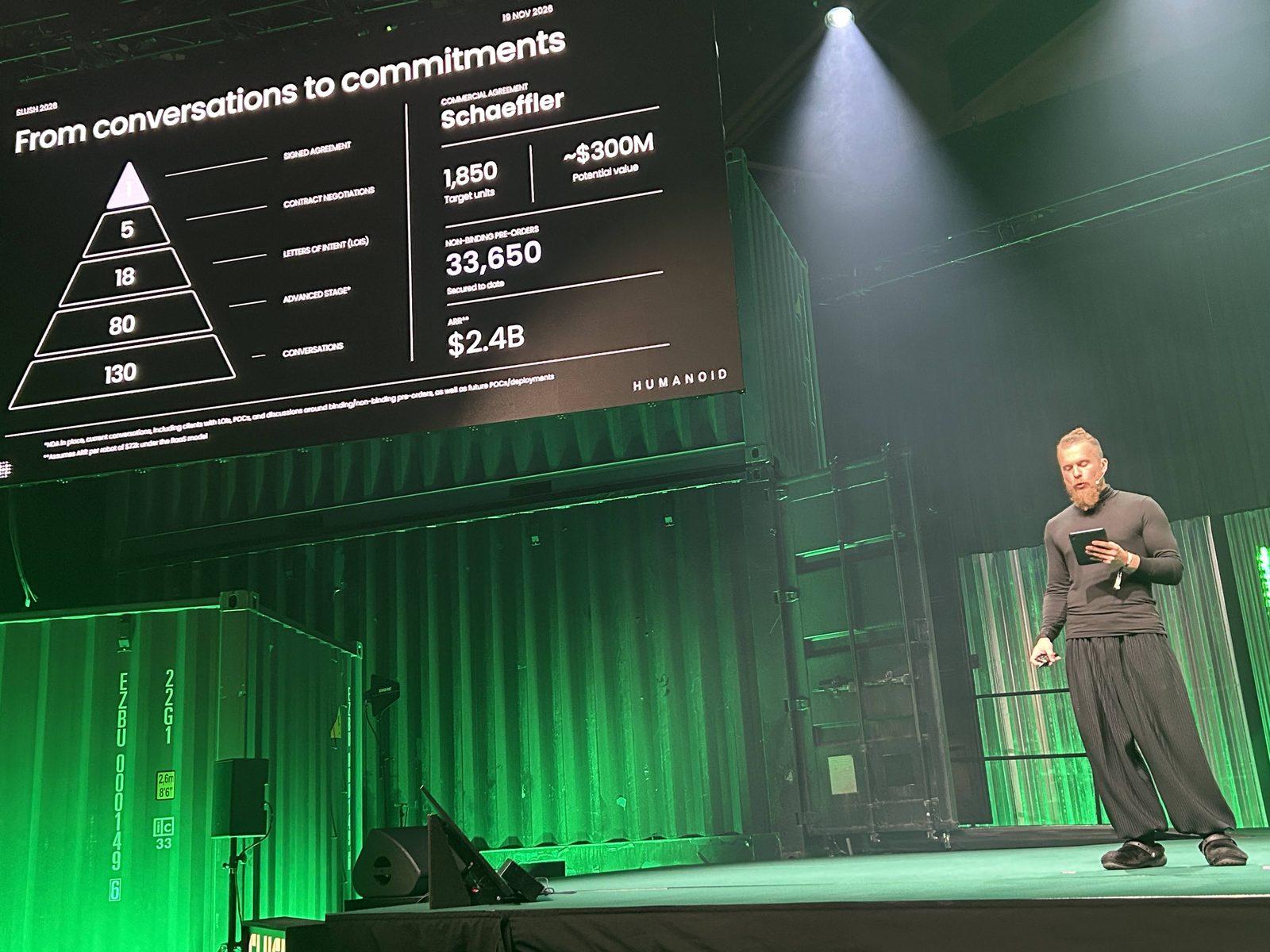
Artem Sokolov (Humanoid) presents a binding agreement with Schaeffler for about 1,850 wheeled robots, alongside a wider pipeline of customer conversations.
Photo: Lars-Fredrik Forberg / Robotics Norway
Manufacturing is planned in steps. From 2027, Bosch will build the next generation of the wheeled robot as contract manufacturer, with a first-year volume of 543 units. Schaeffler supplies the actuators. In 2028 the plan is 4,995 units a year, with Delta and the start of mass production; then 30,000 units in 2029 and 150,000 a year by 2030.
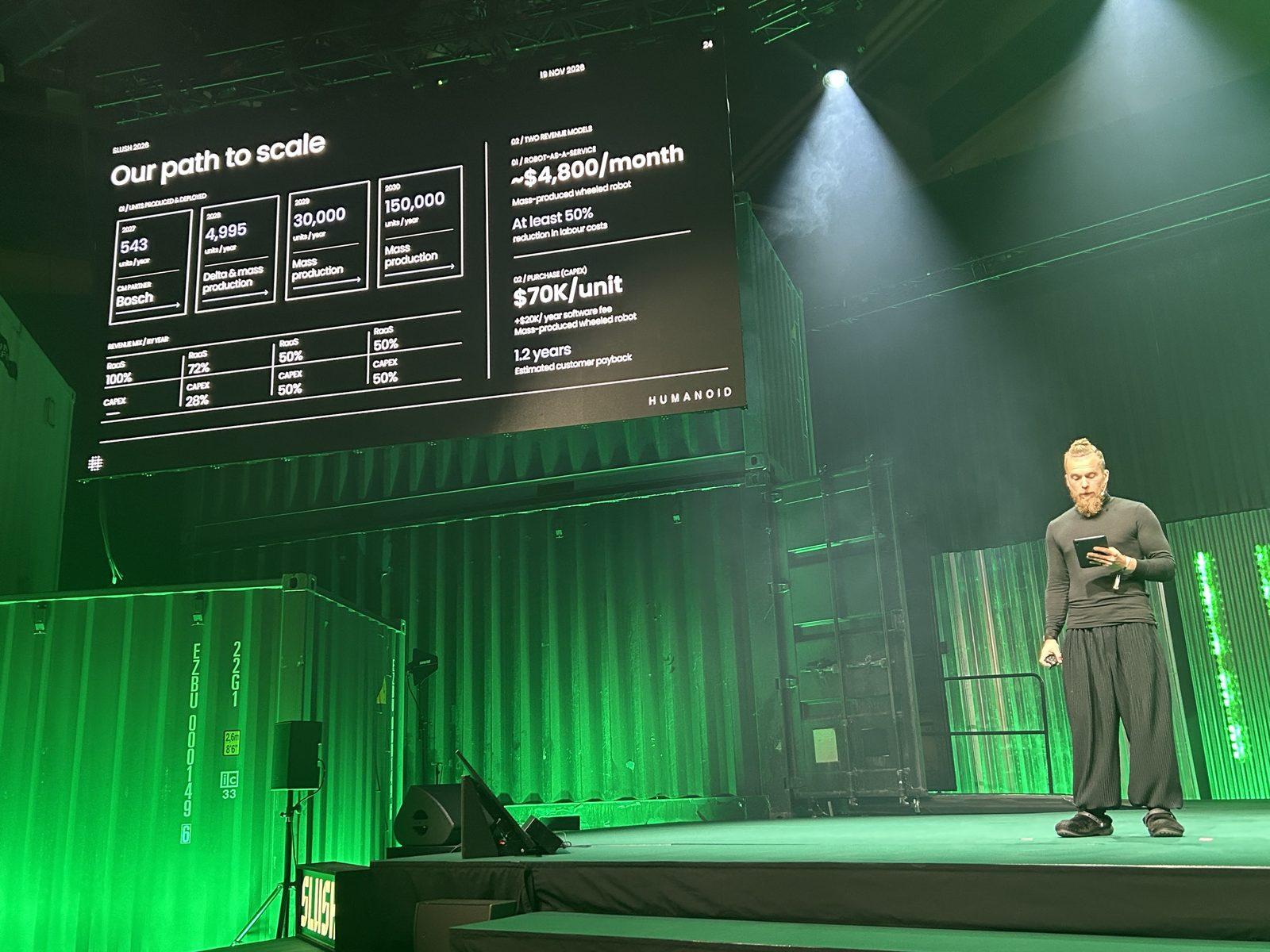
Artem Sokolov (Humanoid) maps a path to 150,000 robots a year by 2030, with Bosch as contract manufacturer from 2027 and a robot-as-a-service offer.
Photo: Lars-Fredrik Forberg / Robotics Norway
The company sells robot-as-a-service first: a monthly fee, around 4,800 dollars for a mass-produced wheeled robot, with no upfront spending, and Humanoid taking care of maintenance, software updates and new skills. That, Sokolov said, cuts labour costs on the tasks the robot takes over by at least 50 percent. A purchase option was also shown, at 70,000 dollars a unit plus a 20,000 dollar annual software fee, with an estimated customer payback of 1.2 years.
Reliability, scale and trust
Sokolov closed with three things he had learned. First, reliability: "A demo has to work once. The factory needs it to work thousands of times every shift." That takes reliability, safety, uptime and smooth integration, which is why, he said, only the full stack works, and one company must be accountable for the whole result. Second, scale takes general-purpose robots that learn new skills, a turnkey offer, and industrial partners who can manufacture at volume, which is why Humanoid works with Bosch and Schaeffler. "Making one robot that works is hard. Making thousands that work every day is much harder." Third, customers need trust and education as much as technology.
"We are not building robots because we want the world to become more robotic. We are building robots because we want the world to become more human," he said, in a future where machines take on repetitive and dangerous work and people have more time to create, explore and be with the people they love. Humanoid is at thehumanoid.ai.
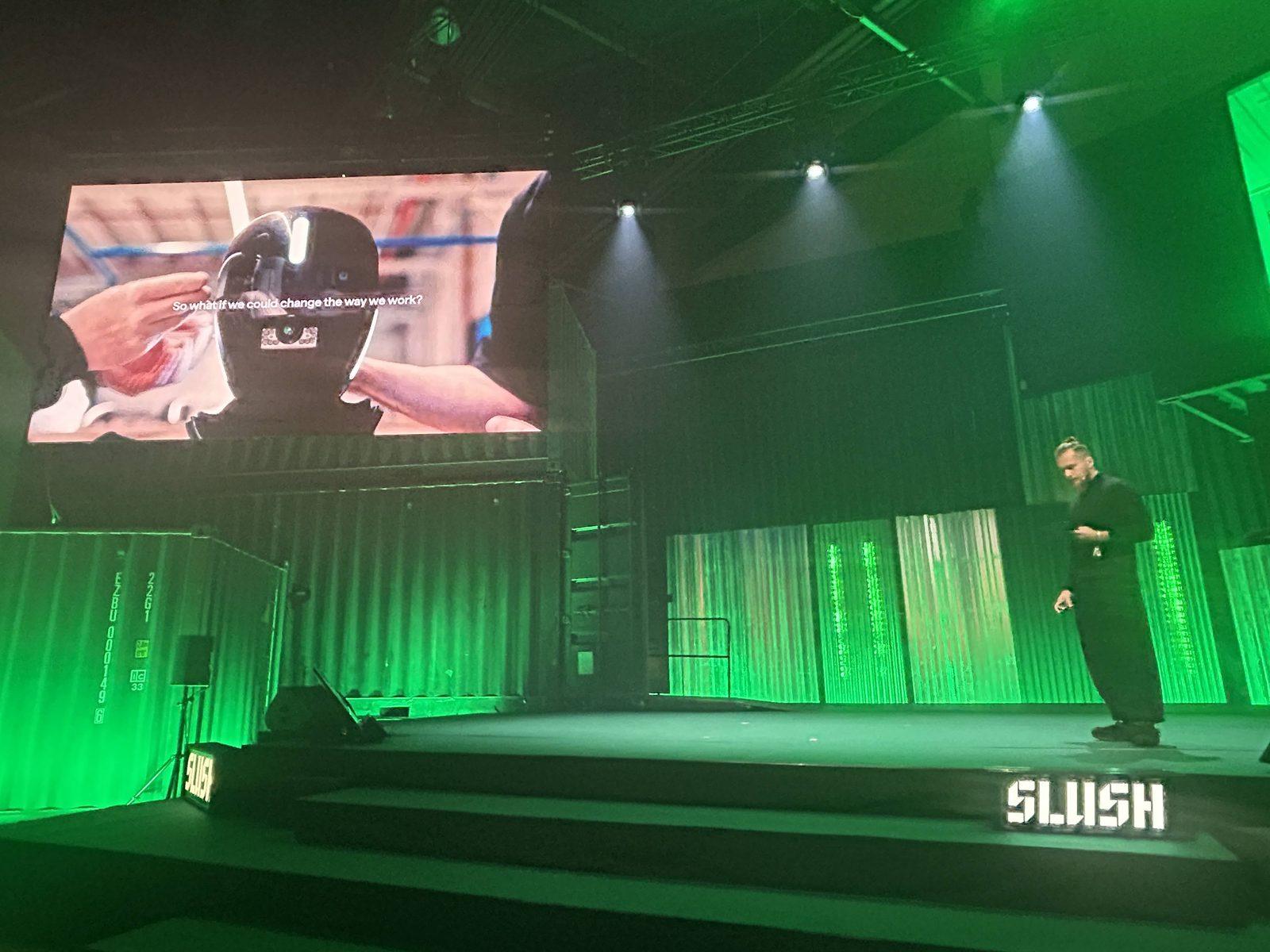
From Humanoid's film "What makes us human?", shown during the talk: What makes us human? Is it what we do? Or what we are capable of? We have always been curious. We ask questions. We explore. And learn. That's how we move forward. Generation after generation. But somewhere along the way, we created a world where people spend their days doing the same things again and again. Working in places that are too cold. Too hot. Too dangerous. Every year, nearly 3 million people die because of their work. And when the working day ends, another one begins. Cooking, cleaning, tidying. 60 billion hours of unpaid labour. Every single day. But is that what makes us human? We don't think so. We believe our greatest strength is not repetition. It's imagination. Our ability to question what exists. To see what could be, and to make it happen. So what if we could change the way we work? What if machines could take on the tasks that hold us back? Not to replace what makes us human, but to give us more room. More time to think. To create. To move forward. Because the future of work isn't just about what machines can do. It's about what humans can become.
Photo: Lars-Fredrik Forberg / Robotics Norway